and the Project Gutenberg Online Distributed Proofreading Team
THE MIRROR
OF
LITERATURE, AMUSEMENT, AND INSTRUCTION.
| VOL. X, NO. 287.] | SATURDAY, DECEMBER 15, 1827. | [PRICE 2d. |
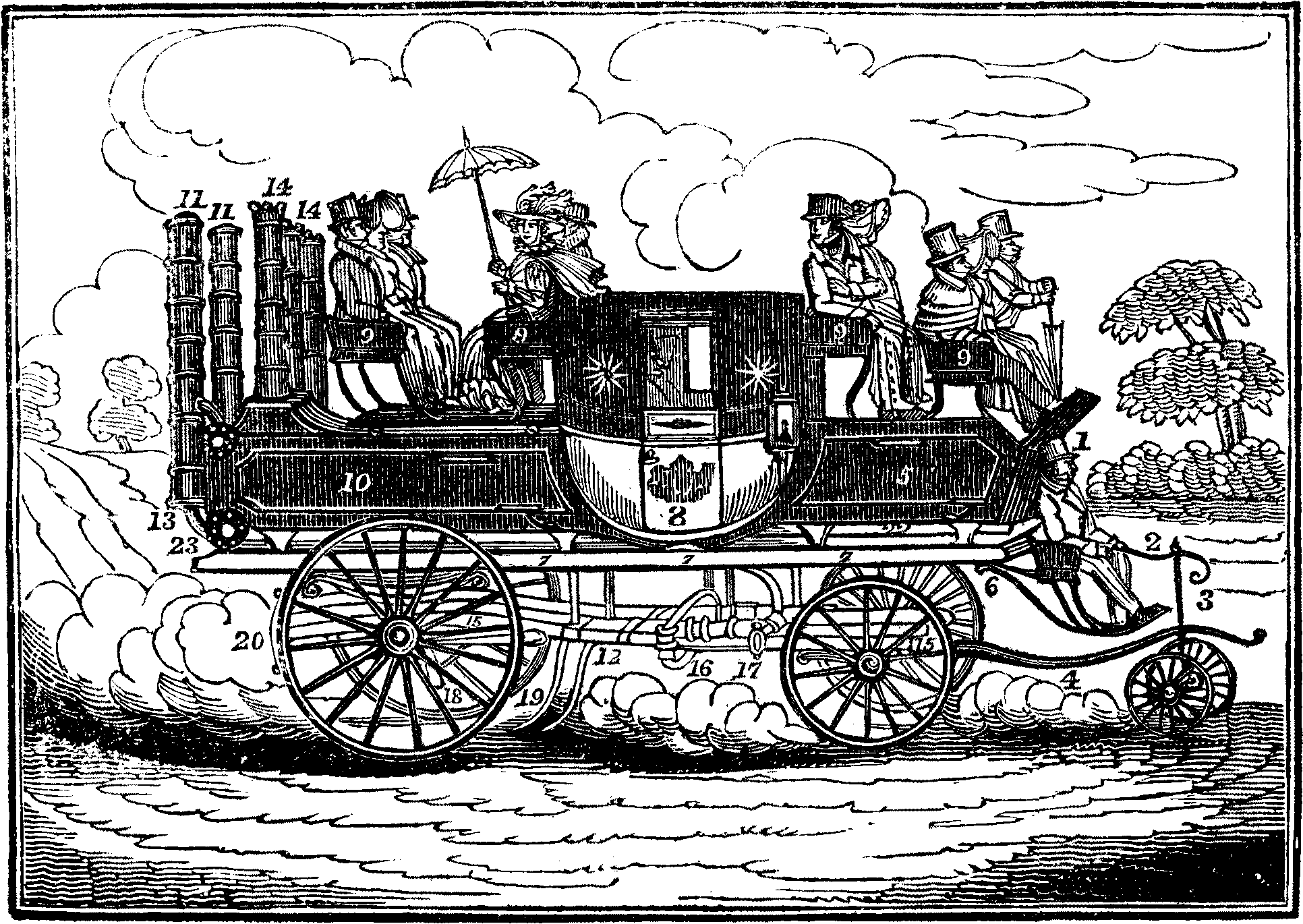
1. The Guide and Engineer, to whom the whole management of the machineryand conduct of the carriage is intrusted. Besides this man, a guard willbe employed.
2. The handle which guides the Pole and Pilot Wheels.
3. The Pilot Wheels.
4. The Pole.
5. The Fore Boot, for luggage.
6. The "Throttle Valve" of the main steam-pipe, which, by means of thehandle, is opened or closed at pleasure, the power of the steam and theprogress of the carriage being thereby regulated from 1 to 10 or 20miles per hour.
7. The Tank for Water, running from end to end, and the full breadth ofthe carriage; it will contain 60 gallons of water.
8. The Carriage, capable of holding six inside-passengers.
9. Outside Passengers, of which the present carriage will carry 15.
10. The Hind Boot, containing the Boiler and Furnace. The Boiler isincased with sheet-iron, and between the pipes the coke and charcoal areput, the front being closed in the ordinary way with an iron door. Thepipes extend from the cylindrical reservoir of water at the bottom tothe cylindrical chamber for steam at the top, forming a succession oflines something like a horse-shoe, turned edgeways. The steam enters the"separators" through large pipes, which are observable on the Plan, andis thence conducted to its proper destination.
11. "Separators," in which the steam is separated from the water, thewater descending and returning to the boiler, while the steam ascends,and is forced into the steam-pipes or main arteries of the machine.
12. The Pump, by which the water is pumped from the tank, by means ofa flexible hose, to the reservoir, communicating with the boiler.
13. The Main Steam Pipe, descending from the "separators," andproceeding in a direct line under the body of the coach to the "throttlevalve" (No. 6,) and thence, under the tank, to the cylinders from whichthe pistons work.
14. Flues of the Furnace, from which there is no smoke, coke andcharcoal being used.
15. The Perches, of which there are three, conjoined, to support themachinery.
16. The Cylinders. There is one between each perch.
17. Valve Motion, admitting steam alternately to each side of thepistons.
18. Cranks, operating on the axle: at the ends of the axle are crotches(No. 21,) which, as the axle turns round, catch projecting pieces ofiron on the boxes of the wheels, and give them the rotatory motion. Thehind wheels only are thus operated upon.
19. Propellers, which, as the carriage ascends a hill, are set inmotion, and move like the hind leg