THE MIRROR
OF
LITERATURE, AMUSEMENT, AND INSTRUCTION.
| Vol. XIX. No. 541.] | SATURDAY, APRIL 7, 1832. | [PRICE 2d. |
THE LOWTHER ARCADE.
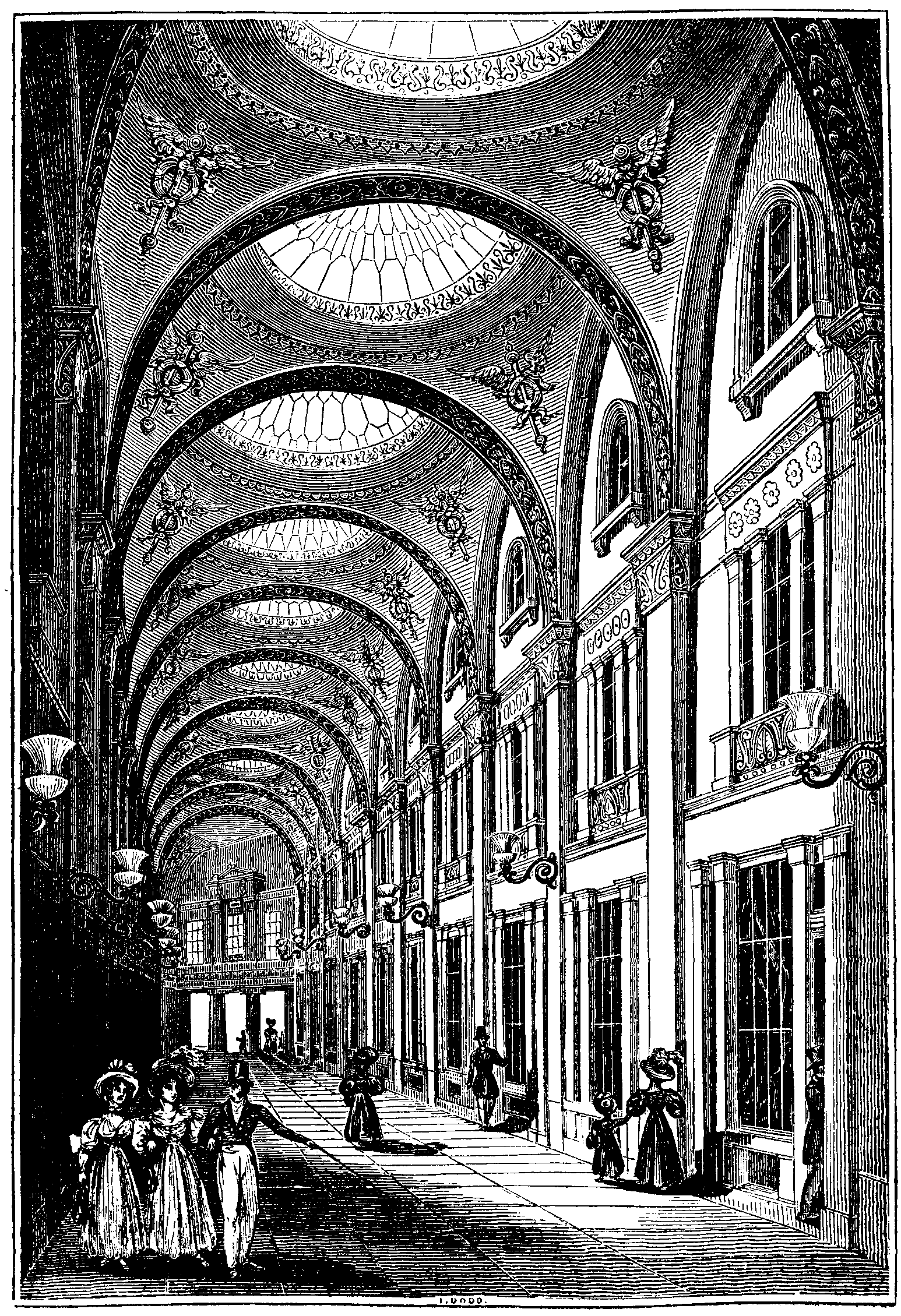
In No. 514 of The Mirror we explained the situation of the LowtherArcade. We may here observe that this covered way or arcade intersects theinsulated triangle of buildings lately completed in the Strand, theprincipal façade of which is designated West Strand.
The Engraving represents the interior of the Arcade, similar in its use tothe Burlington Arcade, and, although wider and more lofty, including threestories in height, it is not so long. The passage forms an acute anglewith the Strand, running to the back of St. Martin's Church, and isdivided by large pilasters into a succession of compartments; thepilasters are joined by an arch; and the compartments are domed over, andlighted in the centre by large domical lights, which illuminate the wholepassage in a perfect manner. "All the shop-fronts are decorated in asimilar manner, and the whole has been designed and executed with greatcare by the builder, Mr. Herbert. The shops on the exterior are designedto have the appearance of one great whole. The style of architecture isGrecian, and the order employed Corinthian: the angles are finished in anovel manner, with double circular buildings, having the roof domed inbrick, with an ornament as a finish to the top of the dome. The effect ofthe whole would be agreeable if it had the appearance of a solid basementto stand upon; but as tradesmen find it necessary to have as much openspace as possible to exhibit their goods, the mass of architecture abovemust appear to be supported by the window-frames of the shops, although inreality they are based upon small iron columns of four and six inchesdiameter, which are scarcely seen, and which offer the slightest possibleimpediment to the exhibition of goods."
We may add that the Arcade at night is lit with gas within elegantvase-shaped shades of ground glass, branching from each side. Theornaments of the domes, especially that of the Caduceus, are introducedwith good effect.
We take the introduction of this and similar passages in the Britishmetropolis to have been originally from the French capital. Thus, in Parisare the Passage des Panoramas; the Passage Delorme; the Passaged'Artois; the Passage Feydeau; the Passage de Caire; and the PassageMontesquieu. A more grandiloquent name applied by the French to some oftheir passages is galerie: we remember the Galerie Vivienne as one ofthe most splendid specimens, with its marchands of artificial luxuries.The Galerie Vero Dodat, (we think shorter than the Lowther Arcade,) isin the extreme of shop-front magnificence: the floor is of alternatesquares of black and white marble, and the fronts are of plate-glass withhighly-polished brass frames, and we doubt whether that common material,wood, is to be seen in the doors. This Galerie is named after itsproprietor, M. Vero Dodat, an opulent <