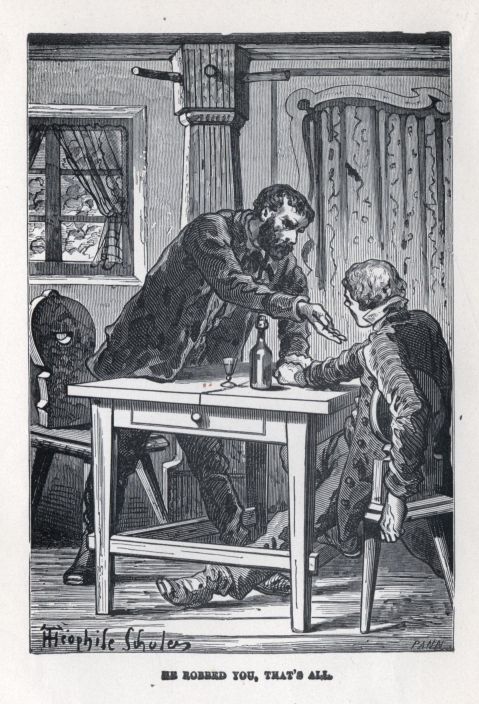
HE ROBBED YOU, THAT'S ALL.
HISTORICAL ROMANCES OF FRANCE
THE PLÉBISCITE
OR
A MILLER'S STORY OF THE WAR
BY ONE OF THE 7,500,000 WHO VOTED "YES"
TRANSLATED FROM THE FRENCH OF
ERCKMANN-CHATRIAN
ILLUSTRATED
CHARLES SCRIBNER'S SONS
NEW YORK::::::::::::::::::::::1911
COPYRIGHT, 1889, 1898
CHARLES SCRIBNER'S SONS
ILLUSTRATIONS
"He robbed you, that's all" . . . . . . . . . . . . . . Frontispiece
"The grapeshot has mown them down. There are none left"
They drew two poor old men from their cellar
There he was, leaning forward to listen
"Good-by, my father! Good-by, my mother!"
INTRODUCTORY NOTE
The present volume serves to emphasize the important connection, sogenerally now lost sight of, between the plébiscite of 1870 in Franceand the war with Prussia which so speedily followed. Under theadministration of Ollivier, which promised an attractive extension ofpopular liberties, it will be remembered, the plebiscitum of theRoman Constitution was borrowed, to give an air of popular approval tothe strongly attacked Imperial régime by taking the sense of the peoplethrough universal suffrage as to the continuance of the Imperialauthority on its then existing basis. Of the web of chicane andcorruption by which the election was brought out an overwhelmingtriumph for Imperialism, MM. Erckmann-Chatrian give a clearer and moreimpressive notion in this book than could be obtained from entirevolumes of parliamentary reports and whole files of newspapers. Butthey make it especially clear how the people were persuaded to return amajority of "yeses" so enormous as to make it impossible to account forit on the theory of mere corruption and chicane. It is evident fromthis narrative that the people were made to believe that the Empiremeant peace abroad and freedom from foreign complications thenthreatening, as well as tranquillity at home, and that therefore one ofthe profoundest instincts of twenty millions of peasantry was utilizedin order to be subsequently betrayed.
No authors could have been so happily chosen to write the story of thestruggle which followed. Alsace and Lorraine, at once the scene of theearliest campaign of the war and the victims of its result, furnish themost appropriate background of such a picture. In reading theseadventures, sufferings, meditations, and discussions of the simple yetshrewd Alsatian miller and his neighbors, the reader will take inalmost at a glance the causes, incidents, and consequences of one ofthe greatest of modern wars. The corruption of the office-holdingclasses, the ignorance of t