Transcribed from the 1891 Henry and Co. edition by DavidPrice,
ESSAYS IN LITTLE.
by
ANDREW LANG.
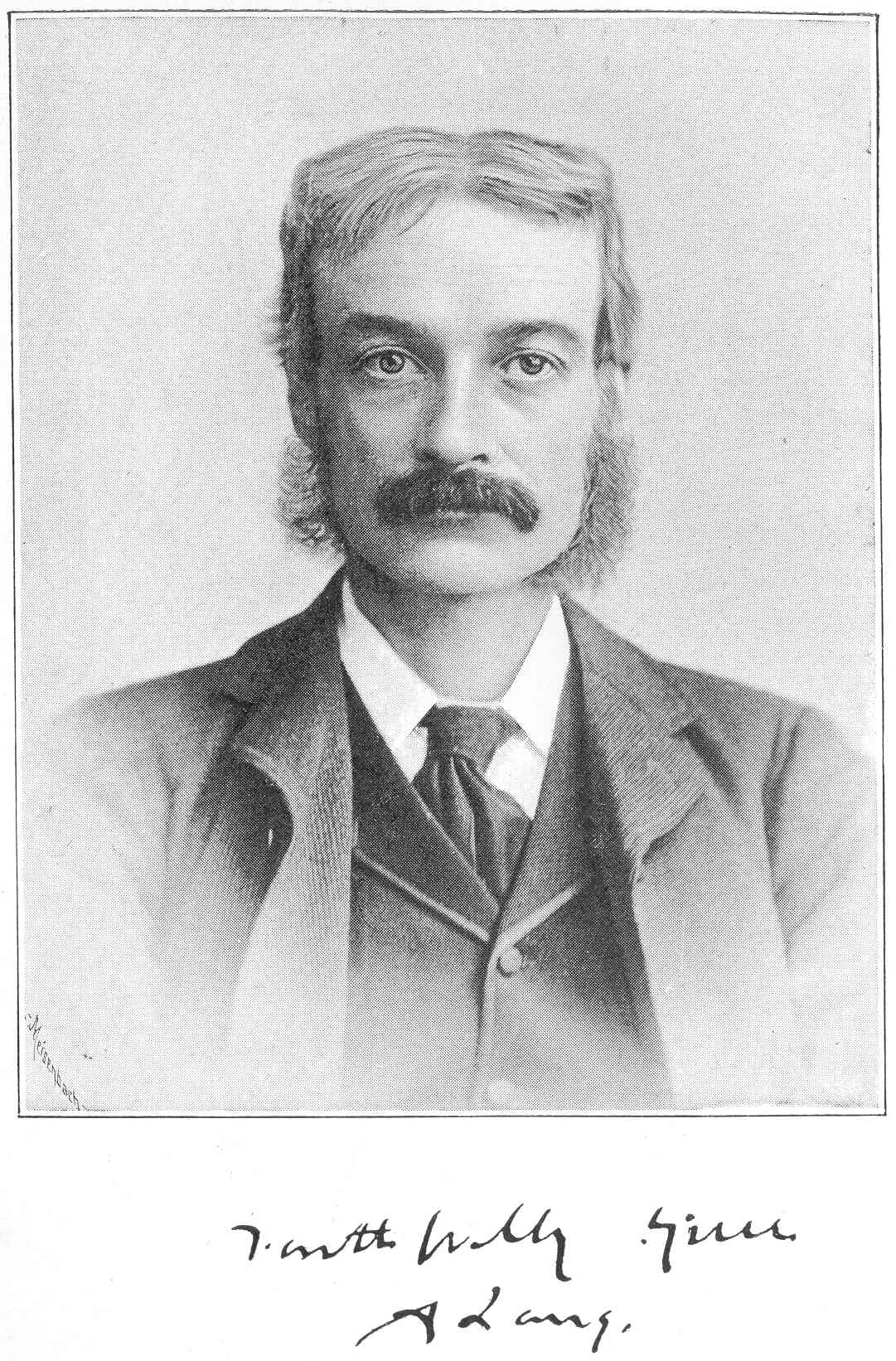
withportrait of the author.
london:
HENRY AND CO., BOUVERIE STREET, E.C.
1891.
Printed by Hazell,Watson, & Vincy, Ld., London andAylesbury.
CONTENTS.
Preface
Alexandre Dumas
Mr. Stevenson’s works
Thomas Haynes Bayly
Théodore de Banville
Homer and the Study of Greek
The Last Fashionable Novel
Thackeray
Dickens
Adventures of Buccaneers
The Sagas
Charles Kingsley
Charles Lever: His books, adventures and misfortunes
The poems of Sir Walter Scott
John Bunyan
To a Young Journalist
Mr. Kipling’s stories
PREFACE
Of the following essays, five are new, and were written forthis volume. They are the paper on Mr. R. L. Stevenson, the“Letter to a Young Journalist,” the study of Mr.Kipling, the note on Homer, and “The Last FashionableNovel.” The article on the author of “Oh, no!we never mention Her,” appeared in the New York Sun,and was suggested by Mr. Dana, the editor of that journal. The papers on Thackeray and Dickens were published in GoodWords, that on Dumas appeared in Scribner’sMagazine, that on M. Théodore de Banville in TheNew Quarterly Review. The other essays were originallywritten for a newspaper “Syndicate.” They havebeen re-cast, augmented, and, to a great extent, re-written.
A. L.
ALEXANDRE DUMAS
Alexandre Dumas is a writer, and his life is a topic, of whichhis devotees never weary. Indeed, one lifetime is not longenough wherein to tire of them. The long days and years ofHilpa and Shalum, in Addison—the antediluvian age, when apicnic lasted for half a century and a courtship for two hundredyears, might have sufficed for an exhaustive study ofDumas. No such study have I to offer, in the brief seasonsof our perishable days. I own that I have not read, and donot, in the circumstances, expect to read, all of Dumas, nor eventhe greater part of his thousand volumes. We only dip a cupin that sparkling spring, and drink, and go on,—we cannothope to exhaust the fountain, nor to carry away with us the wellitself. It is but a word of gratitude and delight that wecan say to the heroic and indomitable master, only an aveof friendship that we can call across the bourne to the shade ofthe Porthos of fiction. That his works (his best works)should be even still more widely circulated than they are; thatthe young should read them, and learn frankness, kindness,generosity—should esteem the tender heart, and the gay,invincible wit; that the old should read them again, and findforgetfulness of trouble, and taste the anodyne of dreams, thatis what we desire.
Dumas said of himself (“Mémoires,” v. 13)that when he was young he tried several times to read forbiddenbooks—books that are sold sous le manteau. Buthe never got farther than the tenth page, in the
“scrofulous Frenchnovel
On gray paper with blunt type;”
he never made his way so far as
“the woful sixteenth print.”
“I had, thank God, a natural sentiment of delicacy; andthus, out