and the Project Gutenberg Online Distributed Proofreading Team
THE MIRROR
OF
LITERATURE, AMUSEMENT, AND INSTRUCTION.
| Vol. 20. No. 559.] | SATURDAY, JULY 28, 1832 | [PRICE 2d. |
OPORTO.
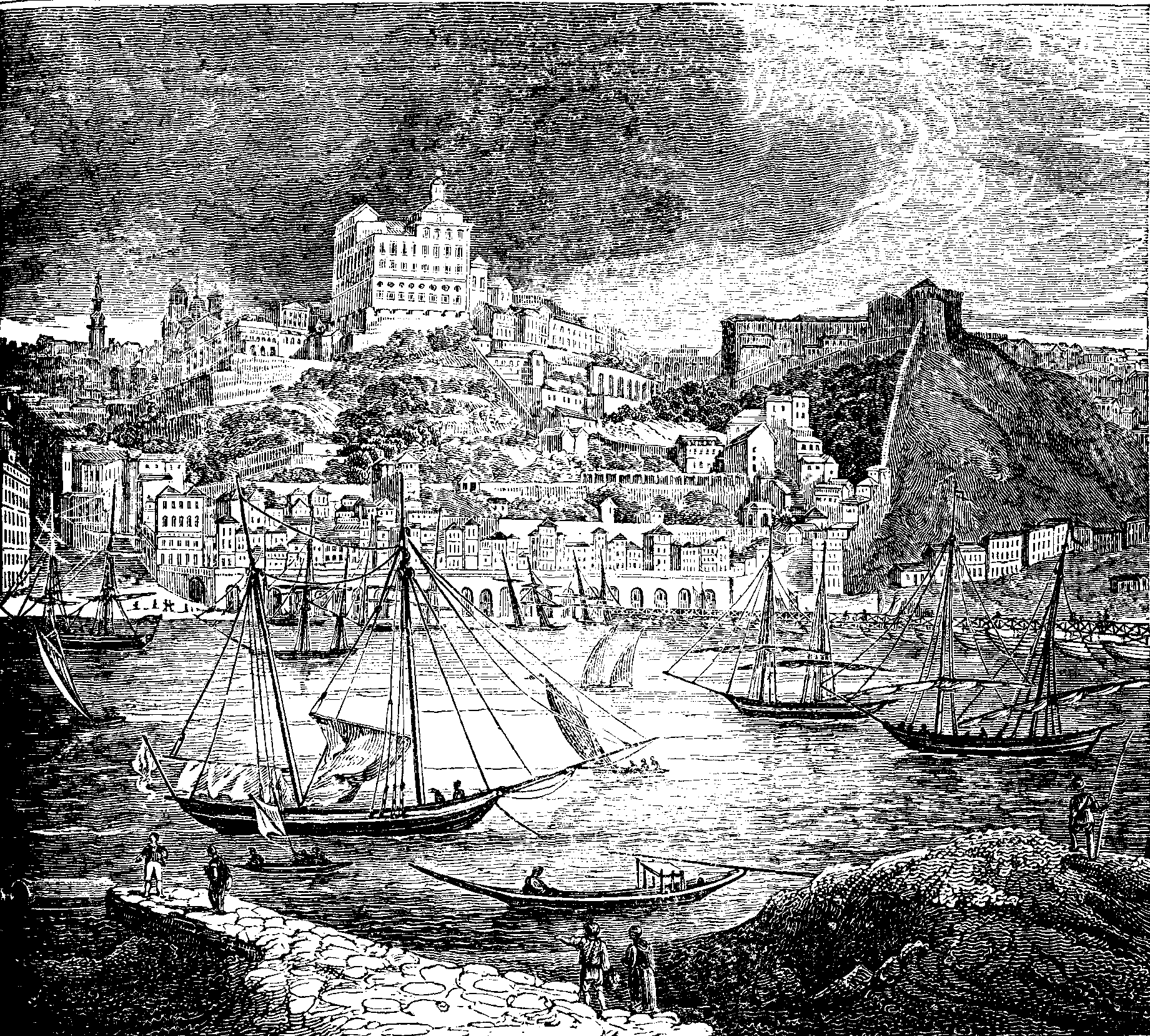 OPORTO.
Persons who are looking for "news from the seat of war" willprobably hail the timely appearance of this Engraving, and regardit as folks sitting at a play do a drop-scene between the acts. Thereader knows our pacific politics: we are of the pen, not of thesword; but we cannot be indifferent to a great political result,when
Old men, and beldams, in the streets
Do prophesy upon it.
Oporto is a place of great commercial as well as politicalconsideration. Thousands of Englishmen have a grateful recollectionof the former importance upon their very lips. Its situation is oneof great natural beauty. It is the largest city in Portugal, Lisbonexcepted. It has been commonly said to owe its origin to theRomans;1 but it appears, from the bestauthors, to have been founded about A.D. 417 by the Suevi, who hadestablished themselves in Braga and other parts of ancient Galicia,but who were driven by the Alani to the banks of the Douro, wherethey fortified themselves on the steep hill now occupied by thecathedral and the bishop's palace, and which is still distinguishedby the appellation of the Cidade de Antiga.
The city occupies the north bank of the Douro, (ancientlyDurius,) about five miles from the mouth of the river, andthe Atlantic Ocean. The approach from thence to Oporto isremarkably beautiful. The dangers of the [pg 50] bar,across the mouth of the river, once passed,2 asuccession of interesting objects present themselves on both sides,as we ascend towards the city. The little town of St. Joao da Fozstands on the north bank, close to the sea, and is the favouriteresort of the wealthier inhabitants of Oporto during the violentheat of the summer. The river, immediately within the bar, expandsinto the appearance of a lake. A little higher up it is narrowed bytwo abrupt hills. That on the right terminates in a precipice ofbright hard sandstone, descending so steeply to the water's edge,that but lately a road has been made from Oporto along the bank ofthe river, to St. Joao da Foz, by blasting and hewing down asufficient portion of the rock. This height, from its precipitoussides, is called the Monte d'Arabida, and forms the westernboundary of a lovely valley, opening upon the Douro, covered withthe Quintas, or villas, of the wealthier inhabitants of theadjoining city. Most of the Quintas at the mouth of the rivercommand delightful prospects of the Atlantic Ocean, and thesplendid effects produced on these scenes at sunset, in thisglowing climate, are almost indescribable. Some idea of its beautymay be form