Transcribed from the 1909 Deighton and Co. edition by DavidPrice,
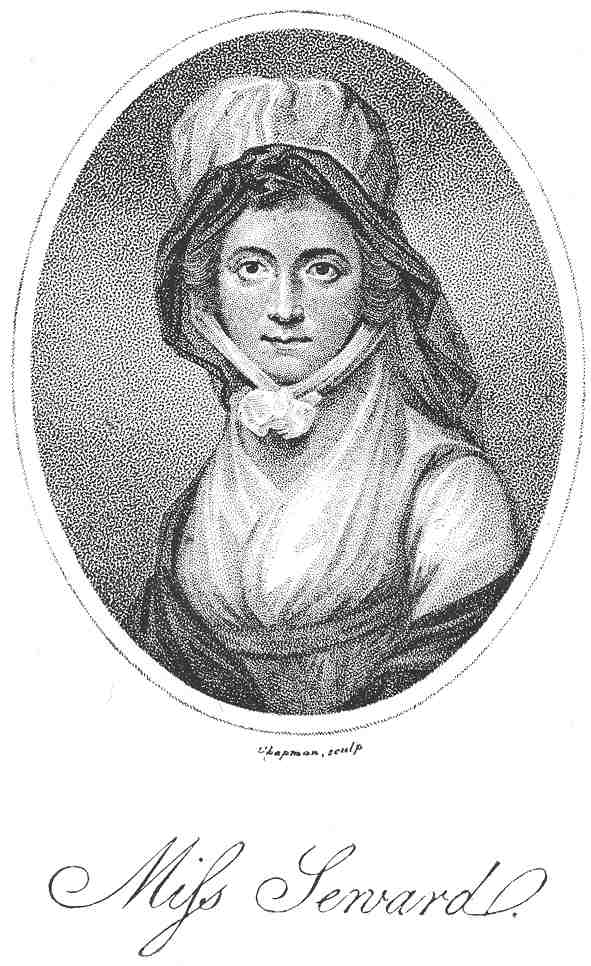
Anna Seward
and
CLASSIC LICHFIELD,
by
STAPLETON MARTIN, M.A.
authorof
“Izaak Walton and his Friends,”etc.
“As long as the names of Garrick, ofJohnson, and of Seward shall endure, Lichfield will liverenowned.”—Clarke.
“Biography, the most interesting perhaps of everyspecies of composition, loses all its interest with me when theshades and lights of the principal characters are not accuratelyand faithfully detailed.”
Extract from a letter of SirWalter Scott to Anna Seward.
Worcester:
printed by deighton and co., high street.
1909.
p.vPREFACE.
Literature and music and science have been found this yearamazingly prolific in centenary commemorations of their greatexemplars, as a leading article in the “Times,” forApril, 1909, has lately reminded us. Yet the death in 1809of Anna Seward, who “for many years held a high rank in theannals of British literature,” to quote the words of SirWalter Scott, has generally passed unnoticed. It is the aimof this book to resuscitate interest in the poetess, and in theliterary circle over which she reigned supreme.
p.1ANNA SEWARD
Anna Seward, a daughter of the Rev. Thomas Seward, destined tobecome, by universal assent, the first poetess of her day inEngland, was born 12th December, 1747. Her mother wasElizabeth, one of the three daughters of the Rev. John Hunter(who was in 1704 appointed Head Master of Lichfield GrammarSchool), by his first wife, Miss Norton, a daughter of EdwardNorton, of Warwick, and sister of the Rev. Thomas Norton, ofWarwick. Anna Seward’s parents were married at NewtonRegis Church, Warwickshire, in October, 1741. The poetesswas born at Eyam in Derbyshire, where her father was then theRector. She was baptized Anne, but she generally wrote hername Anna. Her pet name in her own family was“Nancy,” and also often “Julia.”
Mr. Seward attained some literary fame, and was co-adjutor toan edition of the works of Beaumont and Fletcher. When AnnaSeward was seven years old, the family p. 2removed toLichfield, and when she was thirteen they moved into theBishop’s Palace, “our pleasant home” as shecalled it, where she continued to live after her father’sdeath, and for the remainder of her days.
The derivation of the word “Lichfield” has exciteda good deal of controversy. In Anna Seward’s time, itwas generally thought to mean “the field of deadbodies,” cadaverum campus—from a number ofChristian bodies which lay massacred and unburied there, in thepersecution raised by Diocletian. A reference to“Notes and Queries,” in the Sixth and Eighth Series,will show an inquirer that later search throws some doubt on suchderivation. St. Chad, or Ceadda (669–672) founded thediocese of Lichfield, and was its patron saint.
The Cathedral, the Venus of Gothic creation, as now existing,was built piecemeal during the 13th and early part of 14thcenturies. The present Bishop’s Palace is of stone,