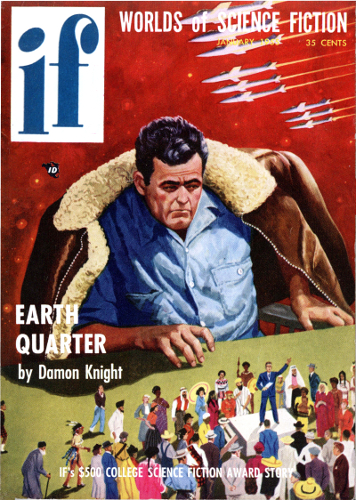
THE EARTH QUARTER
BY DAMON KNIGHT
The Niori permitted refugees from Earth to
live in their cramped little ghetto conditionally:
that they do so peacefully. But there will always
be patriotic fanatics, like Harkway and Rack,
who must disturb the peace....
[Transcriber's Note: This etext was produced from
Worlds of If Science Fiction, January 1955.
Extensive research did not uncover any evidence that
the U.S. copyright on this publication was renewed.]
The sun had set half an hour before. Now, from the window of LaszloCudyk's garret, he could see how the alien city shone frost-blueagainst the black sky; the tall hive-shapes that no man would havebuilt, glowing with their own light.
Nearer, the slender drunken shafts of lamp posts marched toward himdown the street, each with its prosaic yellow globe. Between them andall around, the darkness had gathered; darkness in angular shapes, thegeometry of squalor.
Cudyk liked this view, for at night the blackness of the Earth Quarterseemed to merge with the black sky, as if one were a minor extension ofthe other—a fist of space held down to the surface of the planet. Hecould feel, then, that he was not alone, not isolated and forgotten;that some connection still existed across all the light-years of thegalaxy between him and what he had lost.
And, again, the view depressed him; for at night the City seemed topress in upon the Quarter like the walls of a prison. The Quarter:sixteen square blocks, about the size of those of an Earth city, twothousand three hundred human beings of three races, four religions,eighteen nationalities; the only remnant of the human race nearer thanCapella.
Cudyk felt the night breeze freshening. He glanced upward once at thefrosty blaze of stars, then pulled his head back inside the window. Heclosed the shutters, turning to the lamp-lit table with its hopelessclutter of books, pipes and dusty miscellany.
Cudyk was a man of middle height, heavy in the shoulders and chest,blunt-featured, with a shock of greying black hair. He was fifty-fiveyears old; he remembered Earth.
A drunk stumbled by in the street below, cursing monotonously tohimself, paused to spit explosively into the gutter, and faded into thenight.
Cudyk heard him without attention. He stood with his back to thewindow, looking at nothing, his square fingers fumbling automaticallyfor pipe and tobacco. Why do I torture myself with that look out thewindow every night? he asked himself. It's a juvenile sentimentalism.
But he knew he would go on doing it.
Other noises drifted up to his window, faint with distance. They grewlouder. Cudyk cocked his head suddenly, turned and threw open theshutters again. That had been a scream.
He could see nothing down the street; the trouble must be farther over,he thought, on Kwang-Chow-fu or Washington. The noise swelled as helistened: the unintelligible wailing of a mob.
Footsteps clicked hurriedly up the stairs. Cudyk went to the door, madesure it was latched, and waited. There was a light tapping on the door.
"Who is it?" he said.
"Lee Far."
He unlatched the door and opened it. The little Chinese blinked at him,his upper lip drawn up over incisors like a rodent's. "Mr. Seu sayplease, you come." Without waiting for an answer, he turned and rappedhis way down into darkness.
Cudyk picked up a jacket from a wall hook, and paused for a moment toglance at the locked drawer in which he kept an ancient .32 automaticand two full clips