The Invaders
BY BENJAMIN FERRIS
Heading by Vincent Napoli
[Transcriber Note: This etext was produced from Weird Tales March 1951.Extensive research did not uncover any evidence that the U.S. copyrighton this publication was renewed.]
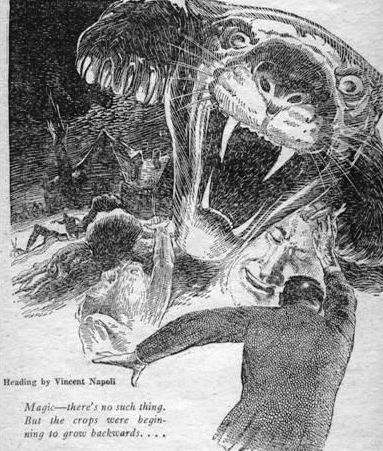
Magic—there's no such thing. But the crops werebeginning to grow backwards....
Big Joe Merklos was the first of them. He appeared at the Wide BendNational Bank one day, cash in hand. The charm of him, his flashingsmile, the easy strength in his big body, were persuasiverecommendations. But the bank's appraisal scarcely got that far. Wasn'the the first buyer in fifteen years for that bone-yard of lonely dreams,Dark Valley?
The county seat of Wide Bend presided over three valleys, correspondingto the forks of the Sallinook River. Once, Dark Valley had been therichest of these. Solid houses and barns stood among orchards laden withfruit, fields chock-full of heavy-bearded grain ... till, one Spring,the middle fork of the river had dried up.
The farmers called in specialists who sank wells and pilot holes,measured the slopes. They heard much talk about water tables, aboutsprings undercutting rock formations. But when it was done the factremained: Dark Valley's water supply was choked off beyond man's abilityto restore it. In the end the farmers gave up, left their dusty housesand shriveled orchards, and Dark Valley died.
Boys hiked over there occasionally. Men scouted for fence posts or pipe.Young couples passed quickly through on moonlight nights. And at leasttwo stubborn old-timers still squatted at the upper end.
Now that Joe Merklos had bought it, of course, they would have to move.
"Well, won't they?" Henderson asked.
Jerry Bronson looked around at the other members of the Wide BendBusinessmen's Club. "Doesn't take a lawyer to answer that, Hen."
"Dam' shame," said Caruso, the barber, who always championed underdogs.
"They've had no equity in that land for years. The bank just let themstay on."
"They can move on over the hill."
Jerry nodded. "Maybe somebody ought to suggest that to them."
"Don't look at me," Caruso said. "Those old coots ain't been near myshop for years."
When the chuckles died, MacAllister, the druggist, voiced the thoughtthat rested unspoken on all their minds. "I wonder if that fellowrealizes what a worthless piece of land he's bought."
"He looked it over." This was Hammond, of the bank.
"'Course, you didn't try to talk him out of it!"
"Would you have?" Hammond retorted indignantly.
Henderson jabbed the air with his cigar. "I think he was a coal miner,back East. Saved up his money to get on the land."
"I think he's a gypsy," Caruso said.
"You ought to know," Tipton, the grocer, laughed. Caruso got fined forhis reply, and with the tinkle of coins in the luncheon club kitty themen dispersed.
Joe Merklos' relatives arrived that night. Henderson, who told JerryBronson about it, had made an early morning delivery of feed nearby, anddriven on to take a look at Merklos' purchase. From the ridge, he viewedDark Valley's three miles of width and six or so of length. Figures weremoving about the gaunt and windowless farm buildings. At least one plowwas in operation, and the good blue friendliness of smoke arose here andthere.
"Looked like a lot of people, Jerry. But you know—I didn't see any carsor trucks around."
Jerry's blue eyes crinkled. Human nature didn't like puzzles any morethan it liked strangers. He returned to the t