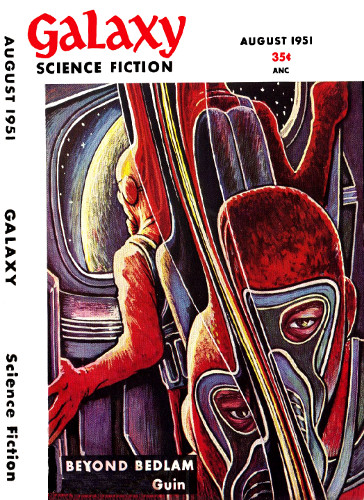
Pictures Don't Lie
By KATHERINE MacLEAN
Illustrated by MARTIN SCHNEIDER
[Transcriber's Note: This etext was produced from
Galaxy Science Fiction August 1951.
Extensive research did not uncover any evidence that
the U.S. copyright on this publication was renewed.]

... Pictures, that is, that one can test and measure.
And these pictures positively, absolutely could not lie!
The man from the News asked, "What do you think of the aliens, MisterNathen? Are they friendly? Do they look human?"
"Very human," said the thin young man.
Outside, rain sleeted across the big windows with a steady faintdrumming, blurring and dimming the view of the airfield where theywould arrive. On the concrete runways, the puddles were pockmarkedwith rain, and the grass growing untouched between the runways of theunused field glistened wetly, bending before gusts of wind.
Back at a respectful distance from where the huge spaceship wouldland were the gray shapes of trucks, where TV camera crews huddledinside their mobile units, waiting. Farther back in the deserted sandylandscape, behind distant sandy hills, artillery was ringed in a greatcircle, and in the distance across the horizon, bombers stood ready atairfields, guarding the world against possible treachery from the firstalien ship ever to land from space.
"Do you know anything about their home planet?" asked the man fromHerald.
The Times man stood with the others, listening absently, thinking ofquestions, but reserving them. Joseph R. Nathen, the thin young manwith the straight black hair and the tired lines on his face, was beingtreated with respect by his interviewers. He was obviously on edge, andthey did not want to harry him with too many questions to answer atonce. They wanted to keep his good will. Tomorrow he would be one ofthe biggest celebrities ever to appear in headlines.
"No, nothing directly."
"Any ideas or deductions?" Herald persisted.
"Their world must be Earth-like to them," the weary-looking young mananswered uncertainly. "The environment evolves the animal. But only inrelative terms, of course." He looked at them with a quick glance andthen looked away evasively, his lank black hair beginning to cling tohis forehead with sweat. "That doesn't necessarily mean anything."
"Earth-like," muttered a reporter, writing it down as if he had noticednothing more in the reply.
The Times man glanced at the Herald, wondering if he had noticed,and received a quick glance in exchange.
The Herald asked Nathen, "You think they are dangerous, then?"
It was the kind of question, assuming much, which usually brokereticence and brought forth quick facts—when it hit the mark. They allknew of the military precautions, although they were not supposed toknow.
The question missed. Nathen glanced out the window vaguely. "No, Iwouldn't say so."
"You think they are friendly, then?" said the Herald, equallypositive on the opposite tack.
A fleeting smile touched Nathen's lips. "Those I know are."
There was no lead in this direction, and they had to get the basicfacts of the story before the ship came. The Times asked, "What ledup to your contacting them?"
Nathen answered after a hesitation. "Static. Radio